Milling was an exercise we did, where you walked round the space, not in circles, but exploring the space and making sure we were filling it. We then added different levels of tension, these were:
1-very slow
2-low/depressed
3-normal/neutral
4-frantic/excited
5-controlled chaos
We also focused on how we moved in the space, walking sideways and backwards and at different levels. Then we created spacial relationships with people in the room, this could involve mirroring another person or just being very aware of their movements and your movements; this could have been done from the other side of the room.
We did this exercise to practice moving as an ensemble, being aware of the people around you and using your peripheral vision.
In yesterdays lesson we did an exercise called pass the clap. We first stood in a circle and Mr Rennison started to pass a clap. To pass the clap you needed to make eye contact with the person you were passing to and then clap toward them. The person would then receive the clap by clapping. This would continue to be passed around the circle, but we did it to a rhythm. To keep the rhythm we all stamped our feet and if our clap went out of rhythm we would have to start aging.
We then made the exercise harder by walking around the room, instead of standing in a circle. We had to continue to walk in the rhythm as we travelled. It was harder to pass the clap whilst walking around, because it wasn't as easy to make eye contact with people because everyone was facing in a different directions to one another.
The point of this exercise was to work on the ensemble' s collect responsibility, their concentration and keeping the rhythm/beat.
1.What is the function of the iconography used in the title sequence of the film? How might it help you understand the film? At the beginning of the film 'this is England', there is a series of images that represent different parts of the film and different parts of skinhead culture. We see lots of concrete in the first images and run down estates, which could suggest poverty or unemployment. There are images of computer games and children's TV shows, that could show the innocence of Shaun before he joins the skinhead gang. We are shown real footage of royalty, people carrying the English flag and Margaret Thatcher , which are all very traditional 'English' things and demonstrates skinhead's belief in keeping England English !! We also see images of war, suggesting that the skinheads will fight for their country and are prepared to go to war for England. There are images of death and destruction, representing the chaos in Shaun's life after the death of his dad. We are shown an image of a sheep being herded, which shows how the people in the skinhead gang are like sheep, in that they do what the are told and don't fight back; the very much follow the crowd.
2.How is Shaun represented at the very beginning of the film? How does his representation contribute to your understanding of him as the protagonist of the film?
He comes across as a young boy who is being bullied at school, with not many friends, who needs some friends for support. he is quite aggressive and angry, but underneath is just struggling with the loss of his dad, who recently died at war.
3.What do you think about the depiction of the skinhead gang? What are their defining features? Does the director glamorize the gang? Does he demonize it? Give your reasons.
I don't think the gang are glamorized or demonized by the director. I think the view on the skinhead gang is left very much up to the audience. We are allowed to form our own views in them. The gang have been dressed like traditional skinheads and at first the could come across as threatening, but after we are introduced to them, they reveal them selves as ordinary young men, who are well meaning towards Shaun. The character, Combo, who comes in later in the film is more demonized. He is extremely violent and racist. He is a more typical skinhead, who more people would generalize a skinhead to be like. I think the difference between Combo and the rest of the group, outlines how some skinheads do live up to their generalization, but others are very different to who we may think they are.
4.What is the function of Milky in the story? What does his name suggest?
The function of milky is to show that the first skinheads were not racist. Milky is mixed race, but the others except him and he is as much part of the group as any of the others are. The name Milky is ironic, because it suggests that he is white. I think the fact that he calls himself milky and so do the rest of the group, shows that he is trying to fit in and that the others are in slight denial about the fact that he is half Jamaican.
5.What does the gang mean to Shaun? What does Shaun mean to the gang?
The gang is very important to Shaun, they are welcoming and excepting towards him, which is something he hasn'texperienced with friends before. He is being bullied, so when a group of older boys are kind to him, he feels safe and better about himself. The gang are happy to have Shaun as a new friend. They take him in and tell him about their beliefs as skinheads. Later on in the film, it is almost as if shaun has been recruited by the gang to be part of the violence and racism that they believe in.
1.What is your view of how masculinity is defined in the film?
I think that masculinity is a very important theme in the film. Both the men and women are very masculine. This is shown by the drug and alcohol use in the film, which is divided equally between the male and female characters. This made them look like they were older than they actually were and much more hostile.
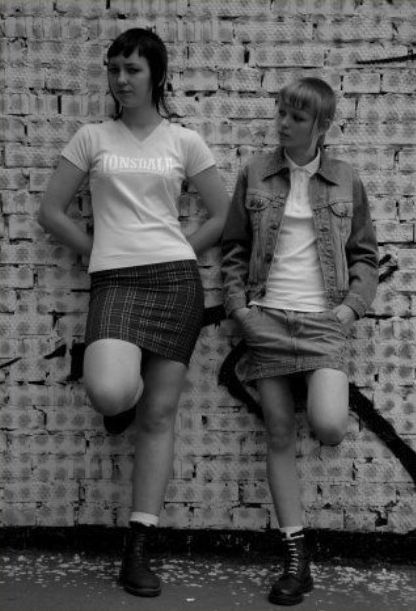
It is also shown by the hair styles, the men have short, shaven heads, which is a typical skinhead style that makes them look tough. The women also have this sort of hair style, with a fringe at the front in some cases, which could suggest that they feel they are equal to the men in their status and that, they too, have the same values and opinions as the men.
finally, the body language of the characters was very 'manly'! The way they stood and walked was at times very threatening and the way they always stood in a gang made them look more dangerous than they would have done standing on their own.
2.Discuss the theme of loss-of-innocence/coming-of-age in the film.
The film is centered around a young young boy, who changes profoundly through out the course of the film. He starts off as a young boy who is lost and very alone. His dad has recently died and he is being bullied at school. He comes across as a fairly innocent child, who has an angry side to him. Further into the film, after he has joined the group of skinheads, we see him change into a very unpleasant and aggressive young man who has formed very strong views, mainly influenced by the people directly around him. As an audience member, it felt quite sad for me that this young boy, who just needed some guidance in life, had had his innocence and childhood taken away from him so early, without a chance to form his own opinions and views on things.
Hello, viewers! Here is our research into the subculture called 'Skinheads'. I'm sure most of you have heard about this popular subculture. However, do you know the real truth about them? Within our research, you will be given an in depth insight into their way of live and more!
How are youth subcultures defined?
Youth
subcultures are groups within young people, who may be defined by their
clothes, work, home, school, family or friends. According to Jordaan in Man
in Context (1984), "a subculture group is a social-cultural formation
that exists as a sort of island or enclave within the larger society.” Sociologists
believe that society is the one who defines the groups, instead of the groups
themselves.
When and why do they emerge?
Many
historians and sociologists argue about the way in which different sub cultures
emerge. The main theory is that when they are forced to enter different social
groups for example school, work, and going into a new location. Notice the word
‘forced’ is used meaning these subcultures don’t always desire to be formed.
How are they perceived by society and
mass media ?
In 2007 the
deaths of three Melbourne teenagers caught the media’s attention. The media exaggerated
this issue by involving the EMO sub culture and social networking for the
suicide and murders.
Also the
language often used in the newspapers (controlled by the media) allows people
to paint young people in a different way. This leads to constant stereotypes
made by people about these youth subcultures.
How were they
perceived by society and by mass media?
In the song ‘London
Skinhead Crew’ by Booze and Glory, it mainly highlights how skinheads are
perceived in this day in age. Within the chorus, it talks about the personality
and characteristics Skinheads have:
Coz we got nothing else to do – this line demonstrates that
they might be quite lazy or feel as they do not have a purpose.
London Skinhead Crew – this line shows that they refer to
themselves as a crew. Google’s definition of ‘crew’ is ‘a group of people that
work closely together’. This shows that the subculture is quite close and operates
together also.
Scars, tattoos, crombie coats, full of trouble – this line
highlights the physical characteristics of skinheads and how they behave.
We grew up on dead end streets – definition of ‘dead end
streets’ – ‘blind alley: a street with only one way in or out’. This shows that
they think that once you’re a skinhead, you won’t be able to stop being one
because you grew up with only one way to do things.
Lack of teeth - full of dreams – the phrase “lack of teeth”
could mean they maybe get into a lot of fights. This means they could be quite
violent at times.
Drinking beer and forever blowing bubbles – “drinking beer”
shows that they enjoy alcohol but “forever blowing bubbles” contrasts on how
skinheads are presented within the chorus Booze and Glory - London Skinhead Crew Music Video:
What images do you
associate with the word “skinhead”?
Does this subculture still exist?
Skinheads do still exist. For example, there are underground
neo-nazi skinheads that live in Canada. They are treated very unfairly because
of the stereotypes and reputation skinheads have. In this article, you will
find much more information of treatment of skinheads in Canada.
When, where and in which social, political and economic contexts did it start?
If you were a skinhead, you were a member of a subculture that originated, among the working class youths of London in the 1960s. When most people think of skinheads, the first thing that comes to mind is often a racist Nazi white male with tattoos all over their body and a generally threatening manner. They might even think of someone like this being involved with the KKK. However originally these was not their intention...
Lots of the young people, in the 1960s spent their money on high end fashion trends that came from American and R&B groups, British rock bands, and even movie stars. These young people became known as mods, who would be known for their consumerism, devotion to fashion, music, and scooters, which were a major staple in this subculture. ( A subculture is a social group within a national culture that has a distinctive patterns of behaviour and beliefs)
However not everyone in this time could afford to keep up with these trends. The 'Peacock mods' were the people that always had the latest fashion trends, money and was known to be the least voilent. While the 'hard mods' was more working class: with less money.
As a matter of fact it started as a reaction against the hippie movement, not race or politics. The first representatives of the movement were greatly influenced by black music imported by immigrants from former Caribbean colonies, Jamaican rude boys and British mods. But by the early 1980s skin heads started to identify them selves with racist/ facist ideas - influenced by the British National Front ( BNF). These views then spread to other parts of the world especially America. Skinheads Against Racial Prejudice (SHARP), were different type of skinheads and would often fight with racist skinheads. Apart from the different views on politics both groups of skinheads listen to the same music and followed the same fashion trends.
Did they have a distinctive style? Hard mods, with the little money they had wore: boots, button down shirts, straight legged jeans and suspenders. If they happened to have money they would wear tonic suits and other classy outfits that they could wear to dance halls where they would enjoy Ska music, rocksteady, and reggae genres. Skinheads often had closely shaven heads (mostly for workforce reasons), which is where the term skinhead came from. By the late 1960s, it was what they were commonly known as.
We found this documentary about skinheads. It demonstrates how the mass media effects youth subcultures and helps us understand the history of skinheads:
4) Skinheads define themselves as superior and respected in
the way that they can hate what they want and discriminate what they want
without consequences. They also seem themselves as the bullies and that they
can bully and hate any race they want. They began their idea of being racist in
Scotland and Northern England.
5) The role of young men and women are that they need to
show their differences between themselves and who they classify the`
disrespectful one`.The role of young
men that were skinheads was leaders and intimidating. Whilst the female
skinheads look like the servants that would cut their hair and buy there drinks
and cigarettes.
6) Youth culture changed over the years because different
skinheads joined together and formed different rules and opinions. There are
quite a lot different groups of skinheads that had mixed together to form
different parades. Some non-racist groups became racist because they were mixed
with racist groups.
The Google definition of a skinhead is- 'a young man of a subculture characterized by close-cropped hair and heavy boots, often perceived as aggressive, violent, and racist.' Clothing
tight jeans
checked shirt
braces
bomber or denim jacket
boots (often Dr martins)
white vests
close shaven hair
Politics and racism
early skinheads were both black and white and were anti south Asian immigrants
first skinheads were not part of any political movement
in the 1970's skinheads started to associate themselves with the White Nationalist National Front.
National Front was a very right wing, whites only political group.
In the late 70's the racist skinhead subculture spread to north America and Europe.
During the early 80's, anti-racist skinhead organisations started up in the USA.
one organisation started up called SHARP. This stands for SkinHeads Against Racial Prejudice.
In this lesson we played a game called kaos! This game involved two layers and next week we are going to add a third layer. I really enjoyed this game, but at times I felt very tense as I was trying to concentrate on doing two layers at the same time and not breaking the sequence. It was also helpful for my concentration skills. We had to try not to be negative when someone forgot the order or dropped the ball, as there is no reason to be negative and it brings the mood down.
Layer 1 Once we had stood in a circle, we went round in a sequence and said someone's name, one after the other, but we couldn't repeat anyone's name. We had to remember this sequence of names; I did this by remembering the person who said my name and the persons name I said, if everyone did this, it was easy to remember. We practiced the sequence a couple of times, doing it faster each time.
Layer 2 for layer 2 we added a new sequence, but this time instead of saying names, we threw an object around the circle. We used a ball, but it could be any object. The same rules applied for the first layer. Once we had formed a completely new sequence, we practiced that for a few time, to become familiar with that sequence. We then added both layers together, so one sequence was started, then Mr Rennison introduced the next sequence in. So whilst you were throwing the ball around, you had to listen out for your name being said as well!
Layer 3 We created a new sequence, by moving to another person in the circle and going to stand in their place. When you replaced a person , they then had to go and do the same thing.Adding this third layer, made the game even more complicated. You had to concentrate on where the people you needed to throw to had moved to, in your peripheral vision.
The play was originally written for the national theater, who started a project to create a series of plays, along side young people who where on the front line of issues making headlines in newspapers currently. young people charity's and local playwrights got together and teamed up with teenagers who had compelling stories. the playwright, Davey Anderson, was put in touch with a 15 year old boy who had been charged with assault, arson and attempted murder, but the boy had luckily been let off with only a probation period, instead of a jail sentence. Anderson interviewed the boy several times and collected lots of recordings from the interviews. he then went away and using the recording he put together a short play, telling a more fictionalized version of the young man's story. the reason this play was written and the reason the national theater set up the this project, was to raise awareness and understanding towards young people who find themselves in difficult situations. The play was deliberately not written from the victims point of view, so that the audience could begin to understand what it was like to be the perpetrator. The play shows how young people who do wrong, or commit crimes, may have a more complicated back story and may not be bad people, just people who have done bad things ( i got the information about the play from the production notes and the website about 'Blackout' )
In the lesson we got into small groups and had to choose eight lines from the play. We only had a small amount of time to prepare a short scene, using these lines and then performed our scenes to the class. This exercise helped us, because it made us have to use physical theatre, as we only had a very limited amount of lines. in our group we did a lot of moving around the stage and used our bodies more than our voices to act out the scene.It helped me to understand how effective physical theatre can be, from watching other peoples scenes and performing our own.
we also discussed the stage configurations we wanted to perform our scenes in. some people decided to perform there scene in the round, end on or thrust. my group decided to perform end on, but seeing other people perform in different configurations also helped you to get an idea of what the whole play would be like, if performed in that configuration.
I also felt that only concentrating of a few lines, as appose to the whole play, made it easier to capture the emotions of the character. This was because it gave you an opportunity to analyse the text carefully and pick out the emotions that you thought may be going through the character in blackout, as he said those lines.
I also tried to work out my physical objectives as I rehearsed. this was good because it is a very physical play and once I knew my objectives in my scene, I found it much easier to perform with my whole body, instead of just my face.
Wednesday, 13 November 2013
Me and my partner answered some questions about finding information...
Where do you go to find information for devising research?
Google
Wikipedia
Bing
Library
Books
News articles
Fire Fox
Films
Documentary’s
Magazines
Encyclopaedias
CDs
Maps
Interviews
Audiobooks
Museums
Sources
Primary source – a person who was there or knows a lot about the subject
How does the internet differ from other sources of information?
It is all in one place
Can be accessed easily
Not all of the information is reliable
Information can be altered
More opinions than facts (Biased)
Easy to find lots of information
Can be constantly updated
people can use it to manipulate information, and make things seem real when they aren't.
what is your favourite place to find information? Our favourite place is Google because it is easy to search for information and there are loads of results so you can look on different websites. Google also often comes up with Wikipedia which we like to use because the information is split up so it is easy to find out what you are looking for.
Similarities between the internet and book based information
They both contain information
They can both be biased
They both have an index
They can both contain secondary and primary information
It could take time to find exactly what you are looking for
It can contain both text and images
Differences between the internet and book based information
Internet is virtual whilst books are Physical
You can access the internet anywhere but you normally have to look in libraries or shops for books
The internet is free and so are library books but you may have to buy books if from a shop
Books normally are long and contain lots of information whereas the internet normally gives you the main, well known facts
It normally takes less time to find what you are looking for on the internet than in a book
fascism is the belief that the way you live your life is the right way and everyone else should conform to your way of life. It often involves racism, nationalism and homophobia. A fascist normally has very extreme right wing views and is very controlling/ruling.
Me and my partner discussed how we would perform the play, if we were the directors.
We would perform the play in the round, but with the actors and the audience both sitting in the circle, making it immersive as well. The actors would get up and meet each other in the middle of the round and either perform the physical theater elements, narrate or both in the round. Different groups could come and do two different physical performances at the same time, therefore varying the layout of the performance, making it more engaging.
I would get some of the text to be said sitting in the audience and the narration would be said either individually or in different sized groups and some parts might even be repeated for impact. The props I would use would be able to double up for different uses. for example you could use a pole for weapons, jail bars, furniture etc. The lighting would be focused into the middle of the round. For the more violent or emotional scenes I would have a dimmer light and in the more hopeful or happier scenes the light would be brighter and might spread onto the audience. Because the majority of the play would be performed in the middle of the circle, it would be very important that the actors were aware of the space and made sure they were constantly moving round, therefor keeping the audience interested.
My first impressions of the play 'blackout' was that it is a very powerful play and includes very difficult themes such as death and depression. I think it clearly portrays different emotions to the audience, because of the style in which it is written and the language used. The play is a stream of consciousness of the character, but it goes back and forward between past, present and future; this makes it interesting and engaging for the audience. Most of the play is directed straight at the audience, instead of at other characters and says thing like, " imagine you did that to somebody", making the audience constantly have to think about the character's situation. the play is very personal to the character and he opens up about his thoughts and feelings, which makes you feel like a privileged listener. I really liked reading through the play as a class. The way it is written makes it very exciting because as you read through it, you can see so much potential for what you can do. We went round the class reading a line each and even though the lines would sometimes only be one word, it really flowed well. There are no stage directions in the play, so it gives idea to create lots of physical theater to go with the text, because the text is just the skeleton of the play.